



MAT 230 EXAM TWO
This document is proprietary to Southern New Hampshire University. It and the problems within
may not be posted on any non-SNHU website.
Jacqueline Amoah
1

∩
| ∩
| | |
| |
| |
| |
Directions: Type your solutions into this document and be sure to show all steps for arriving at
your solution. Just giving a final number may not receive full credit.
P
ROBLEM
1
This question has 2 parts.
Part 1:
Suppose that F and X are events from a common sample space with P (F ) ≠ 0 and P (X) ≠ 0.
(a)
Pro
v
e
that
P
(
X
)
=
P
(
X
F
)
P
(
F
)
+
P
(
X
F
¯)
P
(
F
¯
).
Hin
t:
Explain
wh
y
P
(
X
F
)
P
(
F
)
=
P (X F ) is another way of writing the definition of conditional probability, and then use
that with the logic from the proof of Theorem 4.1.1.
P (X F )P (F ) = P (X F ) is
true
because
we
want
to
get
all
probabilities
of
both
events
occurring
but
want
to
avoid
counting
those
events
that
have
already
been
counted.
When
the
intersection
of
the
probabilities
is
subtracted
we
take
away
those
that
have
been
counted
twice.
Since
all
probabilities
must
add
up
to
1
and
no
more
we
can
say
that
the
addition
of
the
original
probabilities
and
the
complements
of
said
probabilities
will
give
a
value
of
1.
(b)
Explain why P (F X) = P (X F )P (F )/P (X) is another way of stating Theorem 4.2.1 Bayes’
Theorem.
since
P(x)=
P
(
X
F
)
P
(
F
)
+
P
(
X
F
¯)
P
(
F
¯)
and bayes theorem is as follows:
p
(
X
|
F
)
p
(
F
)¯
¯
p
(
X
|
F
)
p
(
F
)+
p
(
X
|
F
)
p
(
F
)
we
can
see
that
the
denominator
and
P(x)
are
equal
so
can
substitute.
Part 2:
A website reports that 70% of its users are from outside a certain country. Out of their users
from outside the country, 60% of them log on every day. Out of their users from inside the country,
80% of them log on every day.
(a)
What percent of all users log on every day? Hint: Use the equation from Part 1 (a).
O= OUTSIDE
I=INSIDE
E=EVERYDAY
p(O)=0.7
p(I)=0.8
p(E)=0.6
P(x)=
P
(
X
F
)
P
(
F
)
+
P
(
X
F
¯)
P
(
F
¯)
P(X)= (1-.8)(0.6)+(0.7)(0.8)=0.68
The probability is.68 or 68 percent.
(b)
Using Bayes’ Theorem, out of users who log on every day, what is the probability that they
are from inside the country?

Baye’s Theorem:
p
(
X
|
F
)
p
(
F
)¯
¯
p
(
X
|
F
)
p
(
F
)+
p
(
X
|
F
)
p
(
F
)
= (0.30)(0.8)/((0.3*.6)+(0.7*.4))=0.521
The probability is 0.521 or 52.1 percent.
/ ≤
/ ≥
P
ROBLEM
2
This question has 2 parts.
Part 1:
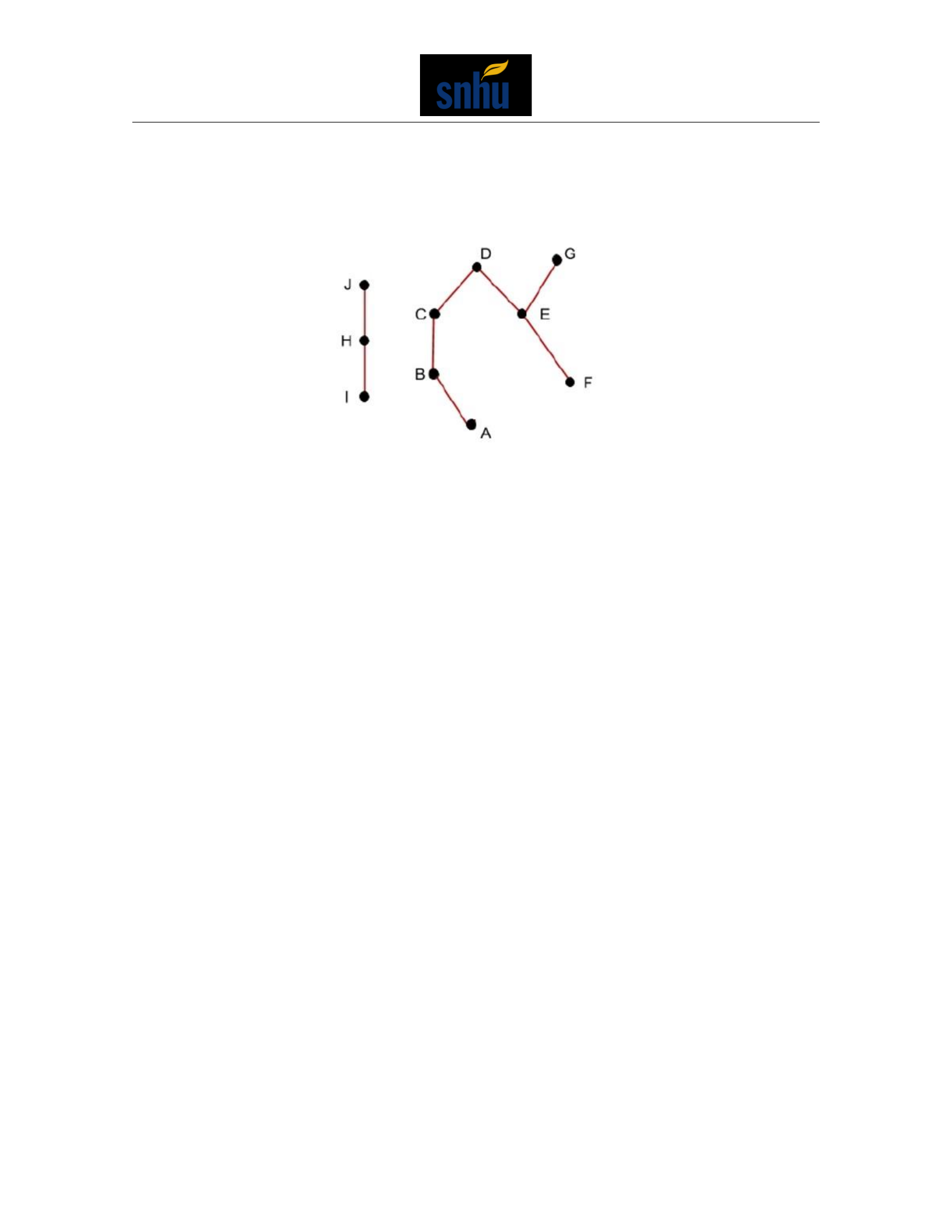
The drawing below shows a Hasse diagram for a partial order on the set:
{
A, B, C, D, E, F, G, H, I,
J
}
Figure 1:
A Hasse diagram shows 10 vertices and 8 edges. The vertices, represented by dots, are as
follows: vertex J is upward of vertex H; vertex H is upward of vertex I; vertex B is inclined upward to
the left of vertex A; vertex C is upward of vertex B; vertex D is inclined upward to the right of vertex
C; vertex E is inclined upward to the left of vertex F; vertex G is inclined upward to the right of vertex
E. The edges, represented by line segments between the vertices are as follows: 3 vertical edges connect
the following vertices: B and C, H and I, and H and J; 5 inclined edges connect the following vertices:
A and B, C and D, D and E, E and F, and E and G.
Determine the properties of the Hasse diagram based on the following questions:
(a)
What are the minimal elements of the partial order?
Minimal elements hold
y=
x and y x.
On
the
diagram
it
would
be
the
points
with
no
connections
below
so,
I,A,F
are
the
minimal
elements.
(b)
What are the maximal elements of the partial order?
Maximal elements hold: y ≠x an y x.
On
the
diagram
it
is
the
points
with
no
connections
above
them
so,
J,D,G
are
the
maximal
elements.
(c)
Which of the following pairs are comparable?
(A, D), (J, F ), (B, E), (G, F ), (D, B), (C, F ), (H, I), (C, E)
Comparable
ordered
pairs
are
pairs
that
can
be
reached
by
travelling
in
a
single
direction.
Out
of
the
list
the
following
are
comparable:
(A,D),(D,B),(G,F),(H,I)
{ }
≤
Part 2:
Consider the partial order with domain 3, 5, 6, 7, 10, 14, 20, 30, 60, 70 and with x y if
x evenly divides y. Select the correct Hasse diagram for the partial order.
(a)
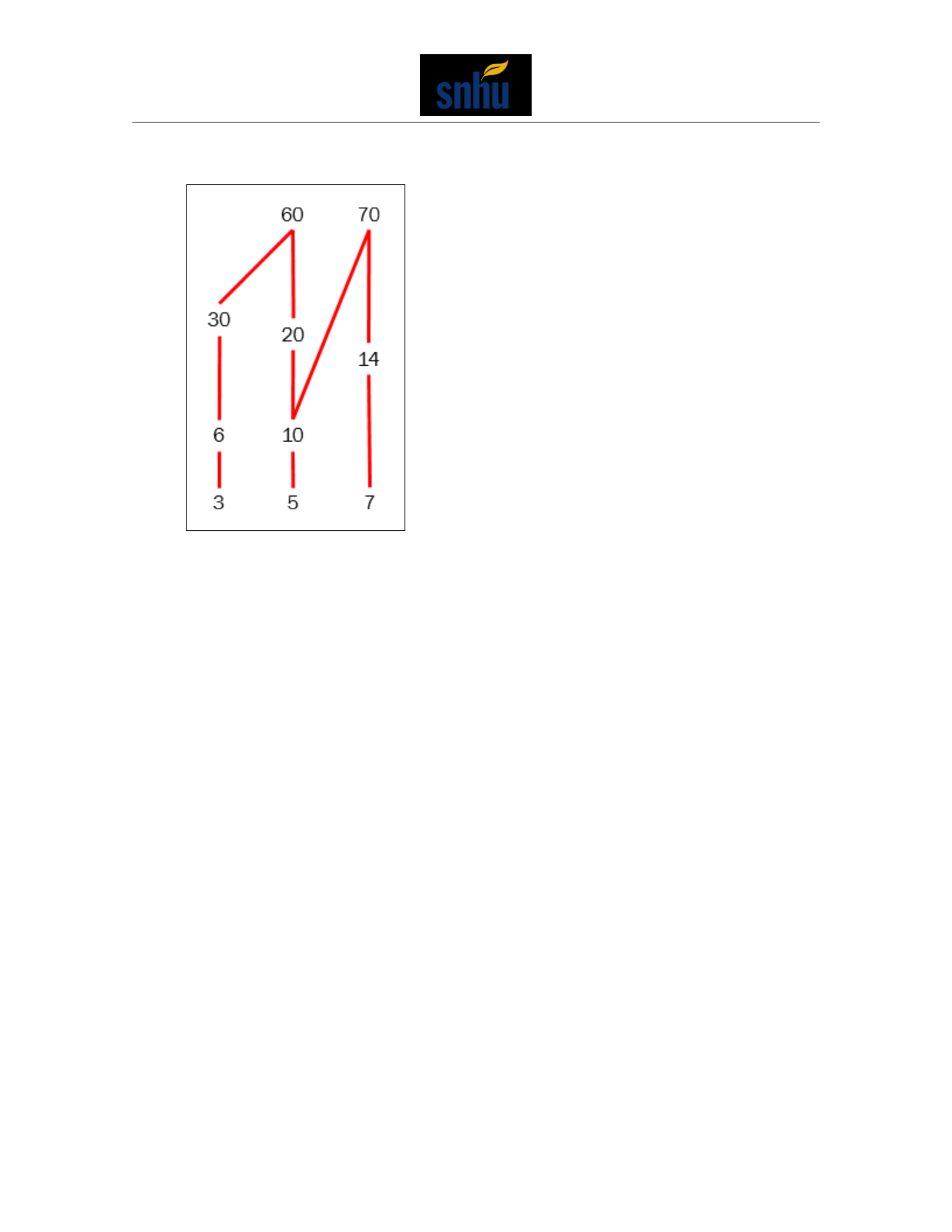
Figure 2:
A Hasse diagram shows a set of elements 3; 5; 6; 7; 10; 14; 20; 30; 60, 70.
There are lines connecting 3 and 6, 6 and 30, 30 and 60, 5 and 10, 10 and 20, 20 and 60, 10
and 70, 7 and 14, 14 and 70.
This diagram is incorrect because the 10 is not connected to the 30 or the 60. Also the 5
is not connected to its multiple of 30.
(b)
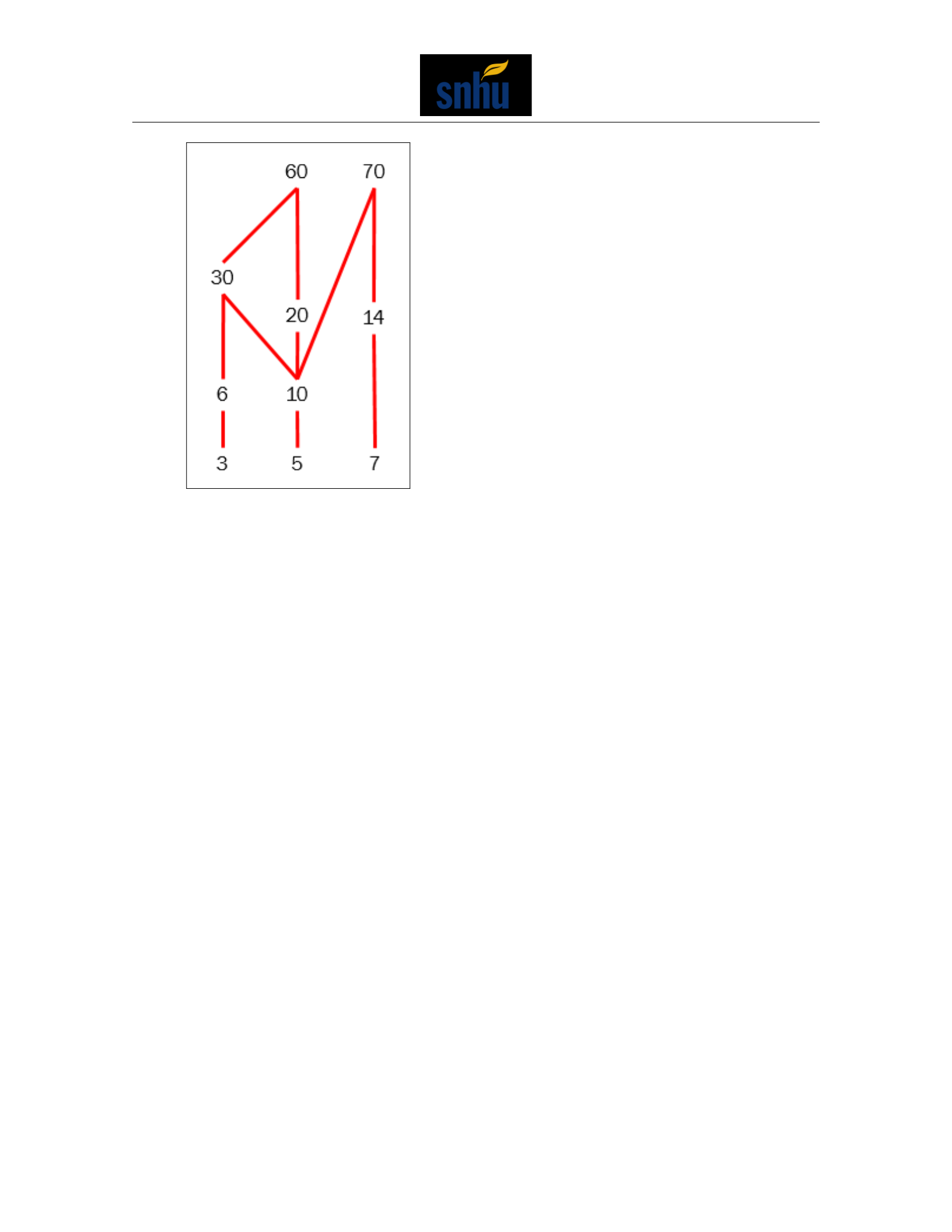
Figure 3:
A Hasse diagram shows a set of elements 3; 5; 6; 7; 10; 14; 20; 30; 60, 70.
There are lines connecting 3 and 6, 6 and 30, 30 and 60, 5 and 10, 10 and 30, 10 and 20, 20
and 60, 10 and 70, 7 and 14, 14 and 70.
This
is
the
correct
Hasse
diagram
because
all
factors
are
connected
to
their
corresponding
multiples.
It
satisfies
the
given
of
x
evenly
dividing
y.
(c)
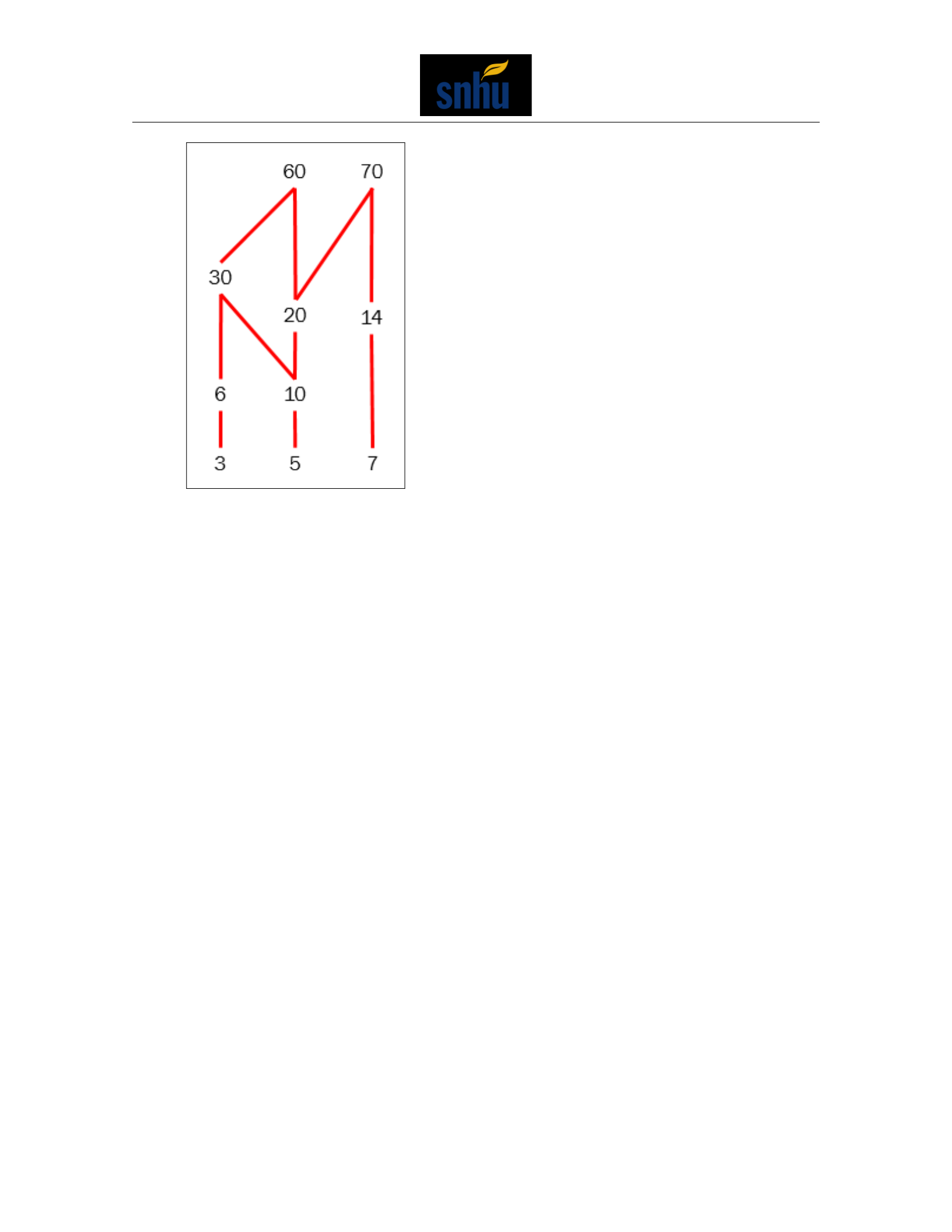
Figure 4:
A Hasse diagram shows a set of elements 3; 5; 6; 7; 10; 14; 20; 30; 60, 70.
There are lines connecting 3 and 6, 6 and 30, 30 and 60, 5 and 10, 10 and 30, 10 and 20, 20
and 60, 20 and 70, 7 and 14, 14 and 70.
This is incorrect because 70 is connected to 20 even though 70 cannot evenly be
divided by 20.Also 5 is not connected to 30 even though 30 can evenly be divided by 5.
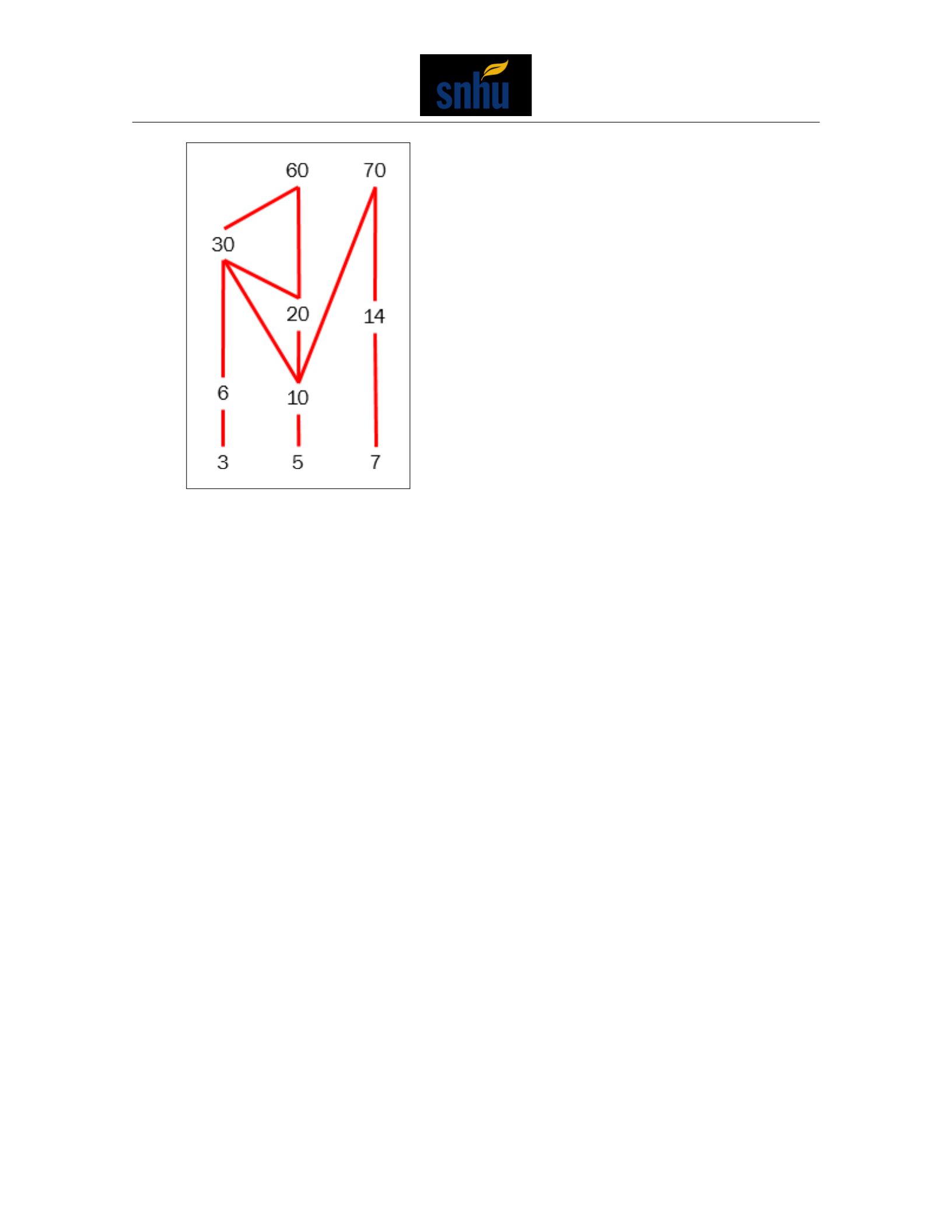
(d)
Figure 5:
A Hasse diagram shows a set of elements 3; 5; 6; 7; 10; 14; 20; 30; 60, 70.
There are lines connecting 3 and 6, 6 and 30, 30 and 60, 5 and 10, 10 and 30, 10 and 20, 20
and 30, 20 and 60, 10 and 70, 7 and 14, 14 and 70.
This is incorrect because 20 is connected to 30. 20 is not a factor of number 30.

P
ROBLEM
3
A car dealership sells cars that were made in 2015 through 2020. Let the cars for sale be the domain
of a relation R where two cars are related if they were made in the same year.
(a)
Prove that this relation is an equivalence relation.
To prove an equivalence relation, we must first define the properties of said relation as
reflexive, symmetry, and transitive.
This
relation
is
reflexive
because
xRx
holds
true.
Since
a
vehicle
can
only
have
1
manufacture
year
it
is
always
related
to
itself.
This
relation
is
symmetric
because
xRy
and
yRx
hold
true.
Since
the
domain
includes
vehicles
manufactured
in
the
same
year
and
x
is
related
to
y
then
y
is
related
to
x.
This
relation
is
transitive
because
xRy,
yRz,
and
xRz
hold
true.
If
x
and
y
are
related
by
manufacture
year
and
y
and
z
are
related
similarly
then
x
and
z
are
related.
This
is
an
equivalence
relation.
(b)
Describe the partition defined by the equivalence classes.
The
classes
are
divided
by
manufacture
year
of
vehicles.
So,
all
vehicles
manufactured
in
2015
would
be
in
the
same
group
as
well
as
all
manufactured
in
2016
would
be
in
one
group
and
so
on.

P
ROBLEM
4
Analyze each graph below to determine whether it has an Euler circuit and/or an Euler trail.
•
If it has an Euler circuit, specify the nodes for one.
•
If it does not have an Euler circuit, justify why it does not.
•
If it has an Euler trail, specify the nodes for one.
•
If it does not have an Euler trail, justify why it does not.
(a)
Figure 6:
An undirected graph has 6 vertices, a through f. There are 8-line segments that are
between the following vertices: a and b, a and c, a and d, a and f, b and c, b and e, b and f, d
and e.
An
Euler’s
circuit
is
a
closed
walk
where
all
edges
are
travelled
exactly
once.
An
Euler’s
trail
is
one
where
all
edges
are
travelled
exactly
once
but
it
is
an
open
walk.
This
is
an
Euler’s
Circuit
because
we
can
start
at
vertex
C
and
used
every
edge
just
once
to
return
back
to
vertex
c.
The
Euler’s
Circuit
is
as
follows:
<c,b,e,d,a,f,b,a,c>
The
edges
used
are
cb,be,ed,da,af,fb,ba,
and
ac.

(b)
Figure 7:
An undirected graph has 6 vertices, a through f. There are 9-line segments that
are between the following vertices: a and b, a and c, a and d, a and f, b and e, b and f, c and
d, d and e, d and f.
An
Euler’s
circuit
is
a
closed
walk
where
all
edges
are
travelled
exactly
once.
An
Euler’s
trail
is
one
where
all
edges
are
travelled
exactly
i
once
i
but
i
it
i
is
i
an
i
open
i
walk.
There
is
no
Euler’s
Circuit
because
there
is
an
odd
number
of
edges
and
there
is
no
closed
walk
such
that
every
edge
is
used
exactly
once.
This
is
an
Euler’s
Trail:
<b,a,c,d,e,b,f,a,d,f>
The
edges
used
are:
ba,ac,cd,de,eb,bf,fa,ad,and
df.

(c)
Figure 8:
An undirected graph has 5 vertices, a through e. There are 4-line segments
that are between the following vertices: b and c, b and e, c and d, d and e.
This
is
neither
i
an
i
Euler’s
i
Circuit
i
or
i
trail
i
because
i
the
diagram
i
is
i
not
i
connected
i
at
i
vertex
a.
Since
the
definition
for
both
states
all
edges
must
be
used
this
mean
all
vertices
will
be
visited
in
either
option
and
we
cannot
visit
vertex
a
from
any
or
the
other
vertices.

(d)
Figure 9:
An undirected graph has 7 vertices, a through g. There are 10-line segments that
are between the following vertices: a and b, a and c, a and f, b and c, b and f, c and d, c and
g, d and e, d and f, f and g.
This
diagram
is
not
a
Euler’s
Circuit
because
there
is
a
i
vertex
of
degree
1.
There
is
no
such
way
to
connect
the
vertices
to
where
all
edges
will
be
used
just
once.
This
diagram
is
not
a
Euler’s
trail
because
there
is
no
such
open
walk
that
all
edges
are
used
only
once.
So
this
diagram
is
neither.
P
ROBLEM
5
Use Prim’s algorithm to compute the minimum spanning tree for the weighted graph. Start the
algorithm at vertex A. Explain and justify each step as you add an edge to the tree.
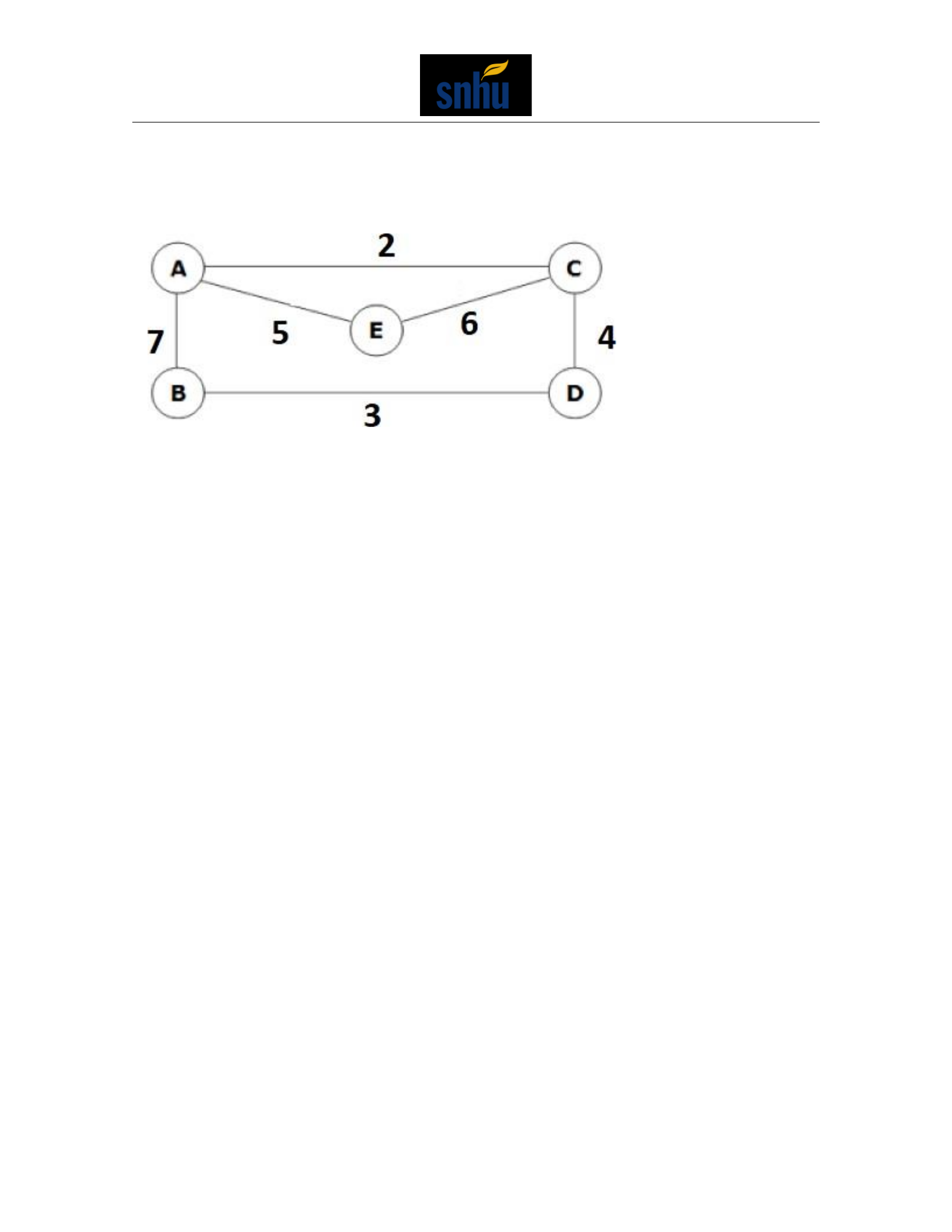
Figure 10:
A weighted graph shows 5 vertices, represented by circles, and 6 edges, represented by
line segments. Vertices A, B, C, and D are placed at the corners of a rectangle, whereas vertex E is at
the center of the rectangle. The edges, A B, B D, A C, C D, A E, and E C, have the weights, 7, 3, 2,
4, 5, and 6, respectively.
When
using
Prim’s
Algorithm,
one
starts
at
the
1st
vertex,
in
this
case
vertex
A.
We then search out all connected edges for the lowest valued edge to travel to get to our next
vertex. We repeat this process until all vertices have been visited. We take the values of the
travelled edges and add them up to get the minimum spanning tree.
For
this
diagram,
we
will
start
with
A
travel
to
vertex
C
using
edge
AC
(value
of
2),
then
travel
to
vertex
D
using
edge
CD
(value
of
4),
to
vertex
B
using
edge
DB
(value
of
3),
to
vertex
a
using
edge
BA
(value
of
7),
finally
stopping
at
the
last
vertex
E
by
travelling
AE
(value
of
5).
Adding
up
all
the
values
we
get:
2+4+3+7+5=21.

P
ROBLEM
6
−
−
∗
−
−
A lake initially contains 1000 fish. Suppose that in the absence of predators or other causes of
removal, the fish population increases by 10% each month. However, factoring in all causes, 80 fish
are lost each month.
Give a recurrence relation for the population of fish after n months. How many fish are there after 5
months? If your fish model predicts a non-integer number of fish, round down to the next lower integer.
Given that the population increases by 10 percent each month, we know that the value of the next
month will be 1.10 times the previous month (100 percent of the current month plus the 10 percent
increase) and taking away 80 fish that is lost each month.
Using
a
sequence,
we
can
note
that
the
population
of
any
given
month
in
the
future
can
be
modeled
by
the
following:
P
n
=
P
n
−
1
+
.10P
n
−
1
80
simplifying
this
equation,
we
get
:
P
n
=
1.10
i i
Pn 1 80
To
find
the
population
of
fish
at
the
end
of
the
5
months,
we
first
need
to
find
the
previous
4-month
values
because
the
5
month
depends
on
its
previous
months.
P
0
=
1000
P
1
=
1.10(1000)
−
80
=
1020
P
2
=
1.10(1020)
−
80
=
1042
P
3
=
1.10(1042)
−
80
=
1066.2
P
4
=
1.10(1066.2)
−
80
=
1092.82
P
5
=
1.10(1092.82)
80
=
1122.1
Therefore,
there
will
be
1,
122
fish
at
the
end
of
the
5th month.

