


MAT 275 MODERN DIFFERENTIAL EQUATIONS Spring 2021
Important: All items in this syllabus are subject to change. Any in-class announcement, verbal or written, is considered an official
addendum to this syllabus. Make sure to be informed! Course materials and information will be accessible through Blackboard.
Instructor: Wenbo Tang Class Time: MW 3:05-4:20pm
Office: Phone: 480-965-1476 Office Hours: MW 1:40-2:50pm
E-Mail: Wenbo.Tang@asu.edu Prerequisites: MAT266 or MAT271 with a C or better
Course Description: Introduces differential equations, theoretical and practical solution techniques.
Applications. Problem solving using MATLAB.
Textbook: Elementary Differential Equations, by Boyce and DePrima - WileyPLUS, 11th edition. There is
also ASU custom edition of this textbook: MAT275 – Modern Differential Equations.
Software: Matlab will be used for lab assignments and is available for free (see below for details).
Calculators: A graphing calculator (e.g. TI84 or Casio CFX-9850GB Plus) is recommended. Graphing calculators
which perform symbolic manipulation (e.g. TI89, TI92, Casio FX2 or 9970G) will not be allowed for tests or quizzes.
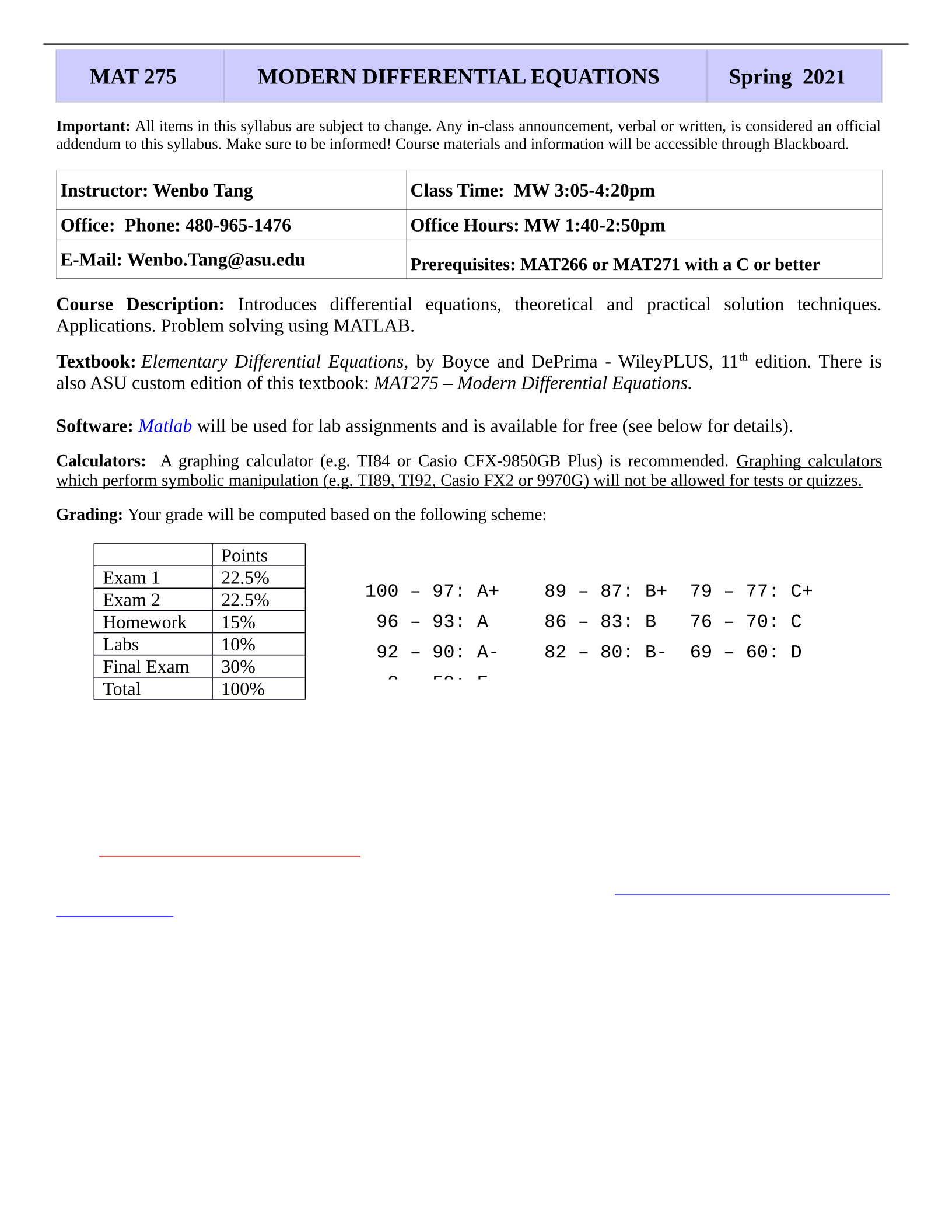
Grading: Your grade will be computed based on the following scheme:
Points
Exam 1 22.5%
Exam 2 22.5%
Homework 15%
Labs 10%
Final Exam 30%
Total 100%
100 – 97: A+ 89 – 87: B+ 79 – 77: C+
96 – 93: A 86 – 83: B 76 – 70: C
92 – 90: A- 82 – 80: B- 69 – 60: D
0 – 59: E
Homework: Weekly homework assignments are given every Monday (beginning Jan. 14th) and are, unless otherwise speci-
fied, due the following Monday at 5pm. You can turn them to my office at WXLR837 or turn them in at WXLR216, the grad-
uate math office. There will be no homework assignments during the weeks of mid-term tests. Please make sure that
you have understood all contents submitted and expect in-class presentation of your solutions. Please write as clearly as pos-
sible to allow proper consideration of your credit. Homework assignments will be posted on Canvas and the due dates noted
there. No late assignments will be accepted.
Suggested Problems: There are practice exam problems at https://math.asu.edu/resources/math-
courses/mat275.
ASU Video Lessons: The websites https://vidman.asu.edu/index.php/menu and
https://math.la.asu.edu/~surgent/video/mat275_exp.html contain video lessons for the course. The former
website is more recently updated, while on the latter the videos are a bit better organized. You are encouraged
to use this as a supplement for the lecture.
ATTENDANCE: Required! Your instructor reserves the right to take attendance and to incorporate your
attendance as part of your overall grade. Also, if you happen to be on the border line between two grades,
attendance will play important role in the decision about your final grade.
MAT 275 Spring 2019 Syllabus 2/6
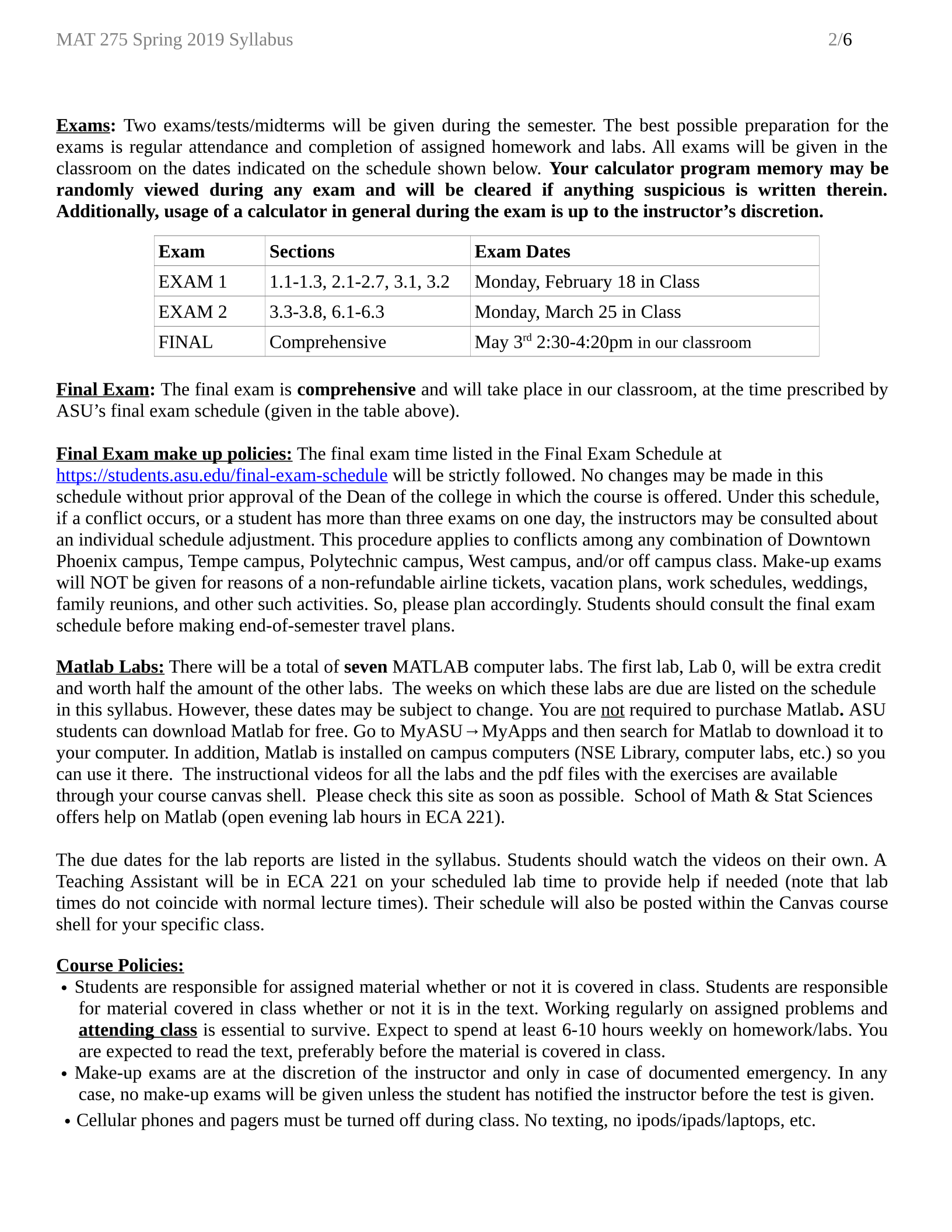
Exams: Two exams/tests/midterms will be given during the semester. The best possible preparation for the
exams is regular attendance and completion of assigned homework and labs. All exams will be given in the
classroom on the dates indicated on the schedule shown below. Your calculator program memory may be
randomly viewed during any exam and will be cleared if anything suspicious is written therein.
Additionally, usage of a calculator in general during the exam is up to the instructor’s discretion.
Exam Sections Exam Dates
EXAM 1 1.1-1.3, 2.1-2.7, 3.1, 3.2 Monday, February 18 in Class
EXAM 2 3.3-3.8, 6.1-6.3 Monday, March 25 in Class
FINAL Comprehensive May 3rd 2:30-4:20pm in our classroom
Final Exam: The final exam is comprehensive and will take place in our classroom, at the time prescribed by
ASU’s final exam schedule (given in the table above).
Final Exam make up policies: The final exam time listed in the Final Exam Schedule at
https://students.asu.edu/final-exam-schedule will be strictly followed. No changes may be made in this
schedule without prior approval of the Dean of the college in which the course is offered. Under this schedule,
if a conflict occurs, or a student has more than three exams on one day, the instructors may be consulted about
an individual schedule adjustment. This procedure applies to conflicts among any combination of Downtown
Phoenix campus, Tempe campus, Polytechnic campus, West campus, and/or off campus class. Make-up exams
will NOT be given for reasons of a non-refundable airline tickets, vacation plans, work schedules, weddings,
family reunions, and other such activities. So, please plan accordingly. Students should consult the final exam
schedule before making end-of-semester travel plans.
Matlab Labs: There will be a total of seven MATLAB computer labs. The first lab, Lab 0, will be extra credit
and worth half the amount of the other labs. The weeks on which these labs are due are listed on the schedule
in this syllabus. However, these dates may be subject to change. You are not required to purchase Matlab. ASU
students can download Matlab for free. Go to MyASU→MyApps and then search for Matlab to download it to
your computer. In addition, Matlab is installed on campus computers (NSE Library, computer labs, etc.) so you
can use it there. The instructional videos for all the labs and the pdf files with the exercises are available
through your course canvas shell. Please check this site as soon as possible. School of Math & Stat Sciences
offers help on Matlab (open evening lab hours in ECA 221).
The due dates for the lab reports are listed in the syllabus. Students should watch the videos on their own. A
Teaching Assistant will be in ECA 221 on your scheduled lab time to provide help if needed (note that lab
times do not coincide with normal lecture times). Their schedule will also be posted within the Canvas course
shell for your specific class.
Course Policies:
Students are responsible for assigned material whether or not it is covered in class. Students are responsible
for material covered in class whether or not it is in the text. Working regularly on assigned problems and
attending class is essential to survive. Expect to spend at least 6-10 hours weekly on homework/labs. You
are expected to read the text, preferably before the material is covered in class.
Make-up exams are at the discretion of the instructor and only in case of documented emergency. In any
case, no make-up exams will be given unless the student has notified the instructor before the test is given.
Cellular phones and pagers must be turned off during class. No texting, no ipods/ipads/laptops, etc.
MAT 275 Spring 2019 Syllabus 3/6
Arriving late to class will not be tolerated.
All email communication must be done from your ASU account, due to FERPA (Family Educational Rights
and Privacy Act). Emails received from other accounts will not be answered.
Cell phones and Electronic Devices
Any student who accesses a phone or any internet-capable device during an exam for any reason
automatically receives a score of zero on the exam. All such devices must be turned off and put away
and made inaccessible during the exam.
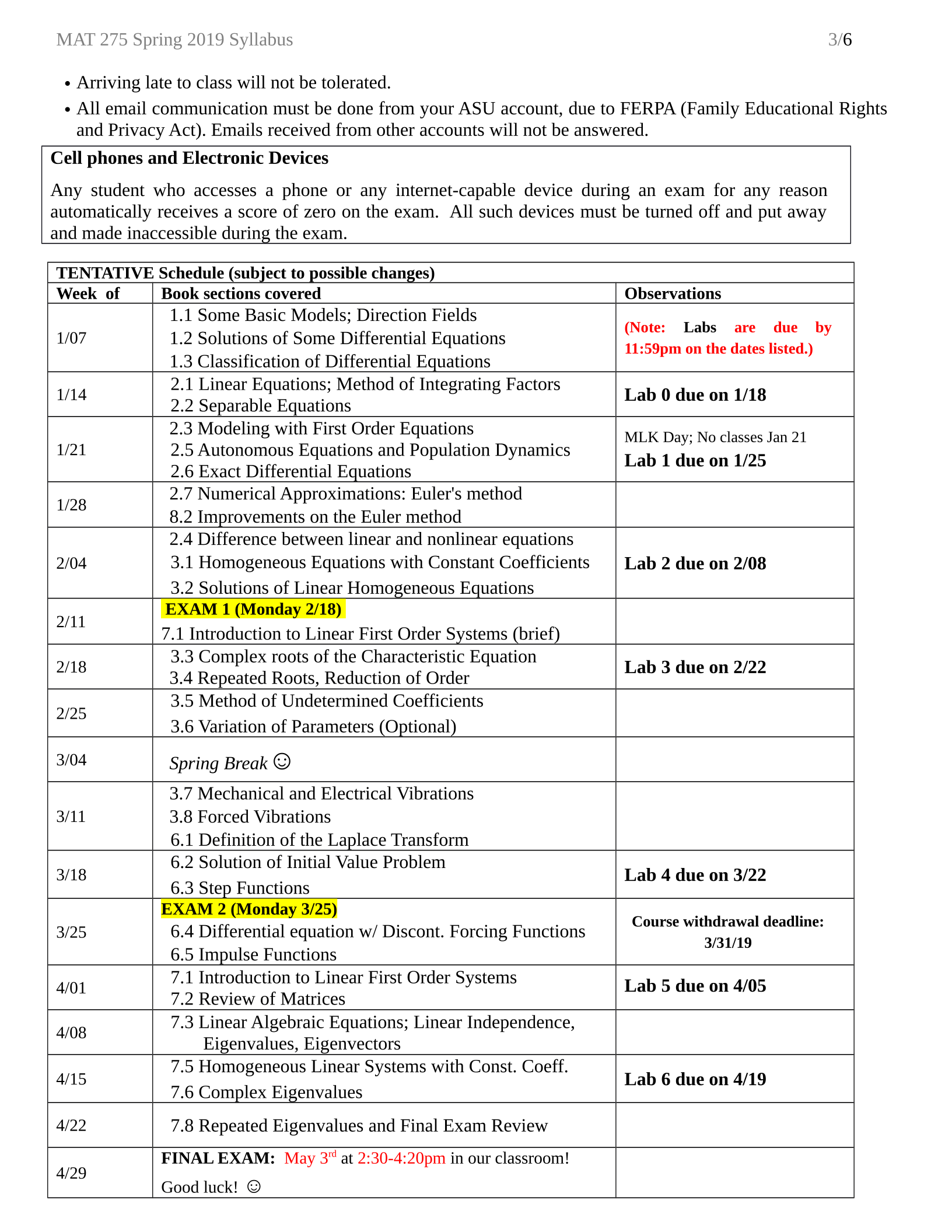
TENTATIVE Schedule (subject to possible changes)
Week of Book sections covered Observations
1/07
1.1 Some Basic Models; Direction Fields
1.2 Solutions of Some Differential Equations
1.3 Classification of Differential Equations
(Note: Labs are due by
11:59pm on the dates listed.)
1/14 2.1 Linear Equations; Method of Integrating Factors
2.2 Separable Equations Lab 0 due on 1/18
1/21
2.3 Modeling with First Order Equations
2.5 Autonomous Equations and Population Dynamics
2.6 Exact Differential Equations
MLK Day; No classes Jan 21
Lab 1 due on 1/25
1/28 2.7 Numerical Approximations: Euler's method
8.2 Improvements on the Euler method
2/04
2.4 Difference between linear and nonlinear equations
3.1 Homogeneous Equations with Constant Coefficients
3.2 Solutions of Linear Homogeneous Equations
Lab 2 due on 2/08
2/11 EXAM 1 (Monday 2/18)
7.1 Introduction to Linear First Order Systems (brief)
2/18 3.3 Complex roots of the Characteristic Equation
3.4 Repeated Roots, Reduction of Order Lab 3 due on 2/22
2/25 3.5 Method of Undetermined Coefficients
3.6 Variation of Parameters (Optional)
3/04 Spring Break☺
3/11
3.7 Mechanical and Electrical Vibrations
3.8 Forced Vibrations
6.1 Definition of the Laplace Transform
3/18 6.2 Solution of Initial Value Problem
6.3 Step Functions Lab 4 due on 3/22
3/25
EXAM 2 (Monday 3/25)
6.4 Differential equation w/ Discont. Forcing Functions
6.5 Impulse Functions
Course withdrawal deadline:
3/31/19
4/01 7.1 Introduction to Linear First Order Systems
7.2 Review of Matrices Lab 5 due on 4/05
4/08 7.3 Linear Algebraic Equations; Linear Independence,
Eigenvalues, Eigenvectors
4/15 7.5 Homogeneous Linear Systems with Const. Coeff.
7.6 Complex Eigenvalues Lab 6 due on 4/19
4/22 7.8 Repeated Eigenvalues and Final Exam Review
4/29 FINAL EXAM: May 3rd at 2:30-4:20pm in our classroom!
Good luck! ☺

MAT 275 Spring 2019 Syllabus 4/6
Course Withdrawal
The course withdrawal deadline is March 31st, 2019.A student may withdraw from a course with a grade of W
during the withdrawal period. The instructor's signature is not required. There is NO automatic withdrawal - a
student does NOT withdraw just by stopping attending classes! It is a student’s responsibility to verify that they
have in fact withdrawn from a class.
Disability Accommodations
Students can request disability accommodations for the class, in case they need them. To qualify for disability
accommodations at ASU, students must be registered with the Disability Resource Center (DRC), which is
located on the 1st floor of the Matthews Center Building; phone: 480-965-1234; hours: Monday-Friday 8:00am-
5:00pm. Please complete this process as soon as possible.
Studying for the class
While diligent, timely completion of the online homework assignments is necessary to master procedural skills,
this alone is usually insufficient to gain conceptual understanding. To master the concepts, you must review and
study your class notes and/or the textbook thoroughly with the goal to understand the connections between the
concepts.
There is a lot of material to be covered and a lot of homework to be done. You should work continuously
throughout the semester, as it is so easy to fall behind. Relying on “just in time” cramming for exams is an inef-
fective study technique and will virtually guarantee failure in the class.
Free Tutoring
Free tutoring is available at the Math Tutor Center WXLR 116, Student Pavilion Center STPV 321, and at
the Engineering Tutor Center ECG 104, throughout the week. Operating hours of math tutoring center and
student pavilion center can be found at https://math.asu.edu/resources/math-tutoring-center, and those of
engineering tutor center at https://tutoring.engineering.asu.edu/courses-tutored-times
The ASU Math Community Center in WXLR 303 is yet another place to get help for the class. The MCC is
open Monday to Friday, 10:30am to 6:00pm.
Classroom behavior
Classroom disturbances, including but not limited to: arriving late, talking in class and using cellular devices are
not tolerated. Each student is expected to show respect for every student registered in the course.
An instructor may withdraw a student from a course when the student's behavior disrupts the educational process
under USI 201-10 http://www.asu.edu/aad/manuals/usi/usi201-10.html
Students are required to adhere to the ABOR Student Code of Conduct:
http://www.asu.edu/studentaffairs/reslife/outreach/abor_code.htm
SoMSS and University Policies and Procedures
For semester deadlines related to enrollment, withdrawal or payments, see the academic calendar available at
http://students.asu.edu/academic-calendar
The grade of Incomplete: A grade of “I” (incomplete) is given by the instructor only when a student doing ac-
ceptable work (that is a C or better) is unable to complete a course because of illness or other conditions beyond
the student’s control. The student and instructor must complete a Request for Grade of Incomplete form if no
MAT 275 Spring 2019 Syllabus 5/6
grade has been reported. If a grade has been reported, the instructor must complete a grade change in the Faculty
Center.
The grade of “I” should be granted only when the student can complete the unfinished work with the same in -
structor. However, an “I” may be completed with an instructor designated by the department chair if the original
instructor becomes incapacitated or is not on campus. The student must arrange completion of the course re-
quirements with the instructor.
The student has one calendar year from the date the grade of “I” is recorded to complete the course. A student
does not reregister or pay fees for a course for which an “I” has been received in order to complete the course.
If the student completes the course within the calendar year, the instructor must submit the grade change using
the Faculty Center, whether the student passed or failed the course.
[The form for incomplete requests mentioned in the policy is here https://students.asu.edu/sites/default/files/in-
completegraderequest11012013.pdf
A student seeking an incomplete is directed to this form. Once the student completes their part, they should bring
it to the instructor for approval].
Instructor-Initiated Drop: At the instructor's discretion, any student who has not attended class during the first
week of classes may be administratively dropped from the course. However, students should be aware that non-
attendance would NOT automatically result in being dropped from the course. Thus, a student should not assume
they are no longer registered for a course just because they did not attend class during the first week. It is the stu-
dent's responsibility to be aware of their registration status.
Final Exam Make-up Policy: The final exam schedule listed in the Schedule of Classes will be strictly fol-
lowed. Exceptions to the schedule and requests for make-up examinations can be granted only by the following
reasons:
1. Religious conflict (e.g., the student celebrates the Sabbath on Saturday)
2. The student has more than three exams scheduled on the same day as the math final
3. There is a time conflict between the math final and another final exam.
Early Examination Requests(Reference: ACD 304–01)
Requests for early final examinations may not be granted by instructors. Requests that seem to have merit may
be referred to the dean of the college in which the student is enrolled. If the dean finds that a student must leave
early because of circumstances beyond the student’s control, the dean may authorize arrangements whereby the
student can complete the course work and take the final examination before leaving. Ordinarily, however, it will
be necessary for the dean to advise the student to clear with each instructor and arrange for an “incomplete”
grade in each course. Under the policy covering “incompletes,” the student must arrange to complete the course
work and take the final examination within one calendar year. If the student is unable to return to the university
to take a final examination for the removal of the “incomplete,” the dean may make arrangements for the student
to take the final elsewhere, under reliable supervision.
Academic Integrity: Academic honesty is expected of all students in all examinations, papers, laboratory work,
academic transactions and records. The possible sanctions include, but are not limited to, appropriate grade
penalties, course failure (indicated on the transcript as a grade of E), course failure due to academic dishonesty
(indicated on the transcript as a grade of XE), loss of registration privileges, disqualification and dismissal. For
more information, see http://provost.asu.edu/academicintegrity.
The grade of XE: A grade of XE is reserved for "failure for academic dishonesty." The grade goes on the stu-
MAT 275 Spring 2019 Syllabus 6/6
dent's transcript; the student needs to petition to have it removed after 1 year.
The grade of EN: A grade of EN is reserved for "failure due to never participated" (never attended a class and
never submitted any assignment). The grade goes on the student's transcript.
Ethics: Students are expected to maintain the highest level of personal ethics when dealing with fellow students,
assistants and faculty in this class.For the university's complete policy regarding ethics, including cheating, pla-
giarism and other forms of academic dishonesty, see the Student Academic Integrity Policy at the following web
address: http://provost.asu.edu/academicintegrity
Student Conduct Statement: Students are required to adhere to the behavior standards of the Arizona Board of
Regents Policy Manual Code of Conduct, Academic Affairs Manual ACD 125Computer, Internet, and Electronic
Communications, and the ASU Student Academic Integrity Policy. Students are entitled to receive instruction
free from interference by other members of the class. If a student is disruptive, an instructor may ask the student
to stop the disruptive behavior and warn the student that such disruptive behavior can result in withdrawal from
the course. An instructor may withdraw a student from a course when the student's behavior disrupts the
educational process according to procedures of the Student Services Manual SSM 201-10.
Powered by TCPDF (www.tcpdf.org)

